How to Record a Family Wedding Contribution

Record a family wedding contribution in one private document that explains who is providing what, what it is intended to cover, and when it is expected. Note whether the family understands it as a gift, a repayable amount, a shared expense, a reimbursement, or a direct payment to a provider.
Keep the date promised separate from the date received or paid. Save receipts, transfer confirmations, invoices, or written acknowledgments with the entry when they are available. In a Peru-focused or Peruvian-diaspora celebration, this simple distinction can prevent a family conversation from being confused with money already available for the wedding.
The record is a coordination tool. It does not replace bank records, provider documents, civil or parish paperwork, or advice about tax and legal questions.
What to Include in the Record
Each entry should contain enough detail for another trusted family member to understand the arrangement without relying on memory.
- Contributor: The person, couple, or family group providing the contribution.
- Recipient or payee: The couple, a relative, venue, vendor, or other party receiving payment.
- Contribution type: Cash, transfer, item, food, labor, professional service, reimbursement, or direct provider payment.
- Amount or item: The currency and amount, or a precise description of the non-cash contribution.
- Intended purpose: The expense or wedding activity the contribution is meant to cover.
- Date promised: When the commitment was discussed and confirmed.
- Expected date: When the money, item, or service should be provided.
- Date received or paid: When the contribution was actually completed.
- Payment method: Cash, transfer, card payment, direct purchase, or another agreed method.
- Family understanding: Whether it is a gift, repayable amount, shared expense, reimbursement, or another arrangement.
- Conditions: Spending limits, preferred providers, timing restrictions, or approval expectations.
- Supporting record: Receipt, invoice, transfer confirmation, message, or written acknowledgment.
- Changes: Later increases, reductions, substitutions, cancellations, or revised dates.
- Refund expectations: What should happen if the purchase is canceled or money is returned.
Use one row or entry for each contribution. If one relative pays several expenses, record each payment separately unless everyone prefers a running total with clear supporting entries.
A Practical Wedding Contribution Record Template
You can keep the record in a spreadsheet, shared document, or private notebook. The format matters less than using the same fields for every contribution.
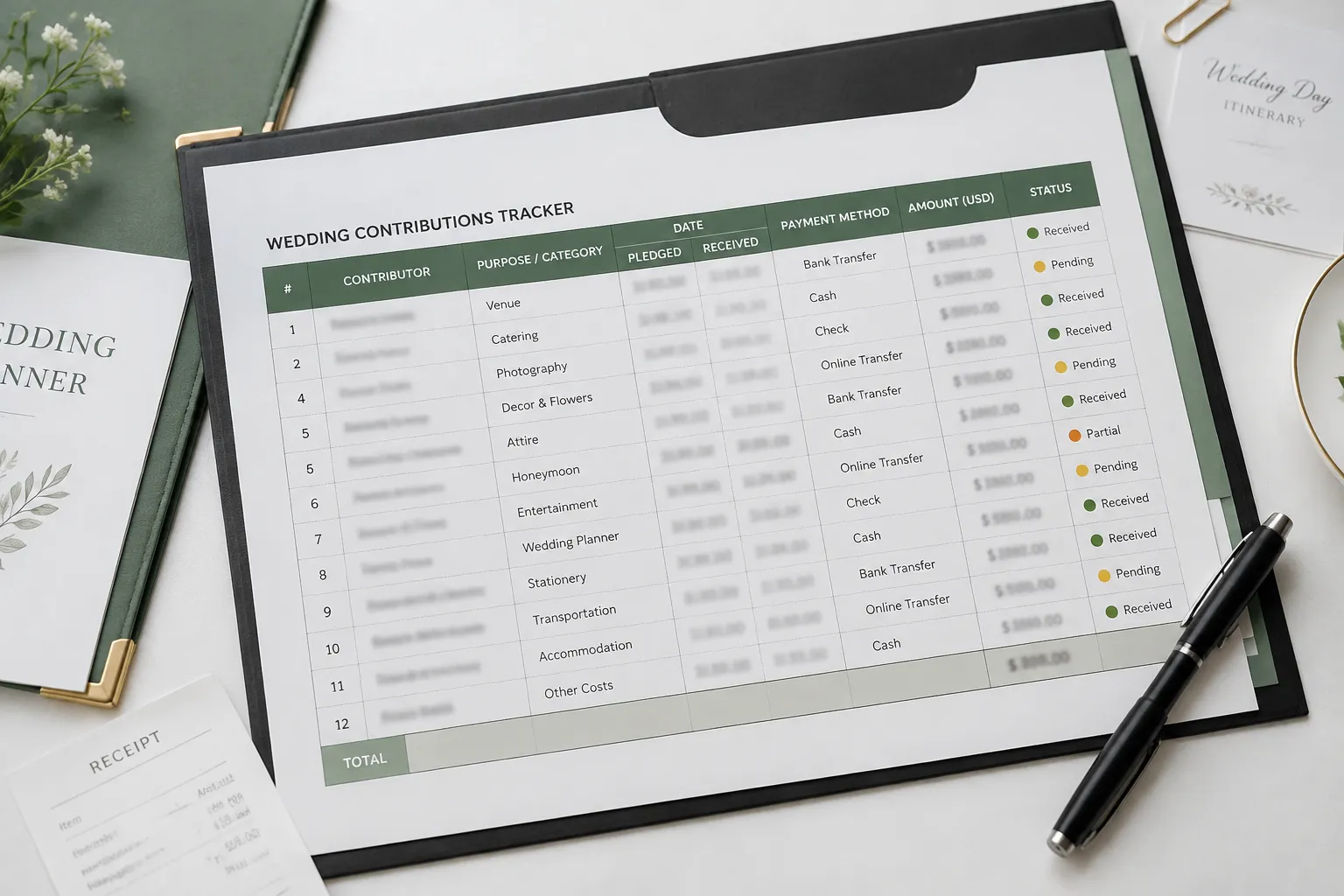
| Field | What to record |
|---|---|
| Contributor | Name of the person or family providing the contribution |
| Recipient or payee | Couple, relative, venue, vendor, or other recipient |
| Contribution type | Gift, repayable amount, reimbursement, shared expense, direct payment, item, or service |
| Amount or item | Currency and amount, or a detailed non-cash description |
| Intended purpose | Named expense such as catering, attire, music, transport, photography, or a parish-related cost |
| Date promised | Date the commitment was made |
| Expected date | Date the contribution should arrive or be paid |
| Date received or paid | Date the contribution was completed |
| Payment method | Cash, transfer, card, purchase, or another method |
| Conditions | Limits or expectations discussed by the family |
| Evidence kept | Receipt, invoice, transfer confirmation, or message |
| Current status | Discussed, promised, partly received, received, paid directly, changed, or canceled |
| Changes and refunds | Revised details and who should receive or control returned money |
| Confirmed by | People who reviewed the entry and the date of the latest confirmation |
This is a private planning record, not a universal accounting form. Families may handle contributions differently across regions, ceremony types, and diaspora settings.
Name the Intended Purpose Clearly
Avoid broad entries such as “wedding help” when the contributor has a particular expense in mind. Write the agreed purpose and state whether the couple can move unused funds elsewhere.
Rosa contributes S/ 2,000 as a gift toward the catering balance. The couple may apply it to another reception expense if the final catering balance is lower.
This wording records the amount, category, and flexibility. If the contribution covers several costs, list the planned allocation or the contributor’s spending priority.
S/ 1,500 for guest transport and related coordination costs, with any remaining amount available for reception expenses.
For a direct provider payment, record both the family contributor and the business receiving the money. Add the related invoice, booking name, payment deadline, and confirmation when available. Provider procedures for payment, cancellation, substitution, and refunds can vary, so check them directly with the relevant provider.
Clarify Gift, Repayable Amount, or Shared Expense
Do not assume that “contribution” has one meaning. One relative may mean a gift, while another may expect repayment, shared decision-making, or future reciprocal support.
Comparative academic research describes communities where cash and non-cash contributions carry different meanings, including records that preserve memory and records that reflect reciprocal expectations. These studies provide context for asking clear questions; they do not establish a Peruvian family custom.
Use the family’s own wording to identify the current understanding:
- Gift: No repayment is expected according to the people involved.
- Repayable amount: Repayment is expected under terms the parties have discussed.
- Shared expense: Two or more people are dividing a named cost.
- Reimbursement: One person pays first and another returns an agreed amount.
- Direct provider payment: The contributor pays the venue, vendor, or other provider.
- In-kind help: The contribution is an item, food, labor, transport, accommodation, or another non-cash service.
Writing “repayable” records the family’s present understanding. It does not by itself settle questions about debt, inheritance, tax treatment, or other consequences. Those questions need separate, current local advice.
Record Cash and Non-Cash Contributions
For a cash wedding contribution record, note the amount, currency, date, recipient, purpose, and handover method. The recipient can acknowledge the payment in the shared record or in a short message.
S/ 800 received in cash from Elena on 14 June for the music deposit. Understood by both sides as a gift with no repayment expected.
Avoid entering only a rounded monthly total. Separate entries make it easier to distinguish personal funds, another relative’s payment, and cash intended for a different expense. If one person collects cash for the couple, record that person and the date the money reaches the couple or final payee.
For a non-cash wedding contribution record, describe the item or service rather than forcing it into a monetary value. Include the quantity, size, duration, person responsible, intended use, expected delivery or service date, completion date, and what happens if the contribution becomes unavailable.
Luis will provide transport for the couple and two family members between the ceremony and reception on 21 September. Pickup times will be confirmed after the photo timeline is finalized.
“Helping with flowers” is less useful than stating whether the relative is purchasing arrangements, transporting them, arranging them at the venue, or contributing a fixed amount. An estimated value may help with internal budgeting, but label it as an estimate. It does not automatically establish a reimbursement amount.
Confirmation Prompts for the Contributor
Before treating a promised contribution as available wedding money, ask:
- What exactly would you like to contribute?
- Is it a gift, repayable amount, reimbursement, shared expense, or another arrangement?
- Is the amount fixed, estimated, or limited to the final cost?
- Which expense should it cover?
- May unused funds move to another wedding expense?
- Who will make the payment?
- Will the money go to the couple or directly to a provider?
- When should the contribution be available?
- Does the contributor expect to review the purchase or provider choice?
- What should happen if the expense changes or is canceled?
- Who should receive any refund?
- How should later changes be communicated?
These prompts are useful when relatives are planning across Peru and a diaspora location, particularly when currencies, payment systems, and time zones differ. Keep the answer beside the entry rather than relying on a later recollection.
Separate Promised, Received, and Paid Amounts
A promise should not appear as completed money in the working wedding budget. Give each entry a clear status:
- Discussed: Possible help has been mentioned, but the amount or item is unsettled.
- Promised: The contribution and purpose have been confirmed.
- Partly received: Only part of the amount, item, or service has been provided.
- Received: The couple or designated recipient has received the contribution.
- Paid directly: The contributor has paid the named provider.
- Changed: The amount, purpose, date, or payment method has been revised.
- Canceled: The contribution is no longer expected.
This matters when a venue or vendor deadline arrives before the family contribution. The couple can then see which funds are available and which still depend on a future payment.
Record Changes Without Erasing the Earlier Entry
Wedding costs, guest numbers, and provider arrangements can change. Preserve the original entry and add a dated update instead of silently replacing it.

On 3 August, the contribution changed from S/ 1,200 for invitations to S/ 900 for guest transport. The contributor and couple confirmed the revised purpose by message.
Record who confirmed the change and when. If the contribution is reduced, note whether the couple will cover the difference or revise the related booking.
For substitutions, describe both the canceled contribution and its replacement. A promise to pay for photography is not automatically the same as providing photography as a family service. Confirm the scope, responsibility, timing, and practical consequences of the new arrangement.
Decide How Refunds Will Be Handled
Refund expectations are easy to overlook when a relative pays a provider directly. Before payment, record who should receive returned funds if the booking is canceled, reduced, or transferred.
- Does the refund return to the contributor or the couple?
- Can a provider credit be used for another wedding expense?
- Who decides whether to accept a replacement service?
- What happens if only part of the payment is returned?
- Will any unrecovered amount remain the contributor’s gift, or become the couple’s responsibility?
The answer may depend on the provider’s current terms and the payment method. Keep the family note alongside the relevant provider documents, but do not treat the two records as interchangeable.
Store the Private Record Carefully
Keep the private family contribution record accessible to the couple and anyone trusted to manage the wedding budget. It may contain names, payment details, family expectations, and copies of financial confirmations.
Use a consistent file name for supporting records, such as:
Contributor - Expense - Payment Date - Amount
Do not place full card details, banking passwords, security codes, or unnecessary identity documents in the contribution file. A receipt number or redacted confirmation is more suitable for routine family reconciliation.
Review each entry before committing to an expense, when the contribution is received or paid, and after a cancellation or refund. The final entry should show what happened, not only what was initially promised.
What This Record Cannot Confirm
No Peru-specific source in the available research establishes one standard meaning for family wedding contributions or one universal recording practice. Expectations may differ by family, region, ceremony type, venue, and diaspora setting.
A private record helps organize conversations and preserve the family’s stated understanding. It does not show that a civil, parish, banking, tax, contractual, or provider requirement has been met.
Check high-stakes questions with the relevant current office, parish, venue, provider, bank, or professional. For the family itself, review each entry together and confirm the contribution type, purpose, timing, conditions, and refund expectations before the next payment or booking.
Sources
- Gift-Giving and Network Structure in Rural China: Utilizing Long-Term Spontaneous Gift Records
- Akuntansi Antropologi: Ritus Pernikahan Jawa Dengan Pembukuan Untuk Nilai Kemasyarakatan
- Tradisi Hitung Waris dalam Walimatul ‘Ursy Masyarakat Melayu
- The Most Ambiguous Gift: Cash and the Presentation Wedding Tradition in Manitoba