Create a Handoff Plan for Family Wedding Ritual Objects
A wedding ritual object checklist helps your family track each item before, during, and after a Peru-focused celebration. Record what the object is, who carries it, where it is collected, when it must arrive, who receives it, where it waits, and who confirms delivery.
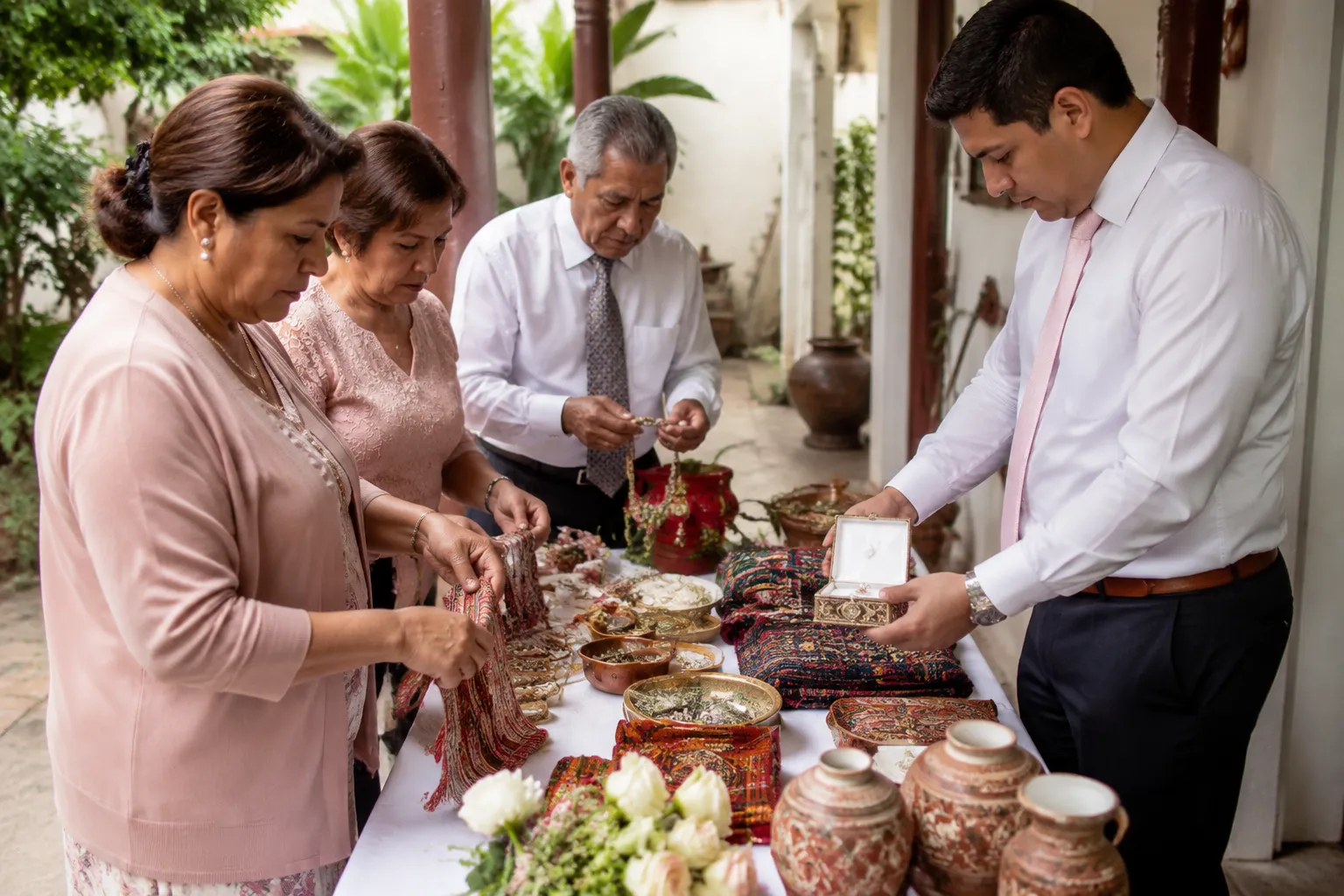
Use the plan as a coordination tool, not as a fixed rule for Peruvian weddings. Families, regions, ceremony types, parishes, municipalities, venues, and diaspora settings may handle objects differently.
Start With the Wedding Ritual Object Checklist
Create one row for every item that may be carried, presented, opened, placed, worn, displayed, or returned. Do not assume an object belongs in the ceremony because a relative, vendor, or product description describes it as traditional.
| Planning field | What to record |
|---|---|
| Object name | The family’s preferred name and a plain description |
| Purpose | Where it may appear during the ceremony, reception, or photographs |
| Condition | Existing marks, fragile parts, missing pieces, or handling needs |
| Contents | Every part that travels with the object |
| Current holder | The person or household holding it before the wedding |
| Responsible carrier | The named person who collects and transports it |
| Collection point | The agreed home, hotel, venue entrance, parish, or other location |
| Collection time | A realistic pickup window and a backup contact |
| Receiving person | The person who takes responsibility when it arrives |
| Opening or placement | Who may open, carry, display, or place it, if the family or ceremony lead has a preference |
| Storage location | The exact place where it waits before use |
| Return plan | Who takes it home, stores it, or returns it afterward |
| Confirmation contact | One person who records each completed handoff |
This structure keeps family meaning separate from delivery logistics. It also gives the couple a practical way to ask questions without treating one arrangement as a national rule.
Identify Each Ritual Object With the Family
Begin with a short conversation among the relatives involved. Ask whether each object comes from family history, ceremony planning, personal preference, decoration, or a vendor suggestion.
- What is the object called in our family?
- Who has kept it until now?
- Is it intended for the civil ceremony, parish ceremony, reception, or photographs?
- Does anyone expect it to be carried, opened, presented, or placed in a particular way?
- Does the ceremony lead need to discuss the arrangement in advance?
- Should it remain with one family after the wedding?
- Is it meaningful to the family, or is it simply part of the planned decoration?
Meanings attached to wedding objects may be shaped by relatives, couples, ceremony expectations, personal preferences, and market language. That does not make the meaning unimportant. It means the family should record its own understanding rather than present one interpretation as a universal Peruvian practice.
If relatives disagree, write down the different expectations. Then ask the relevant ceremony lead or venue contact which arrangements fit the planned setting.
Assign One Responsible Person at Each Stage
Every object needs a named person for each stage. “The family” is difficult to confirm when several people are moving between locations.
- Collecting the object
- Transporting it to the ceremony
- Handing it to the receiving person
- Placing or presenting it
- Moving it between the ceremony and reception
- Returning it after the event
The responsible person does not automatically receive ownership. Their role is to keep the handoff clear.
Choose someone who knows the schedule and can reach the couple, family, venue, and ceremony lead. For an inherited object, ask whether the carrier should be a relative, padrino, elder, or another person chosen by the family.
Do not assume that padrinos or older relatives have the same role in every ceremony. Ask the people involved and record the agreed responsibility.
Confirm Collection Location and Timing
A collection point should be specific enough that the carrier does not need to search. “At the venue” may be unclear when the venue has separate guest, service, reception, preparation, or ceremony entrances.
Record the following:
- The full collection location
- The person releasing the object
- The earliest and latest collection time
- The carrier’s contact information
- A backup person if the first contact is delayed
- Whether the carrier needs permission to enter
- Whether the item travels directly to the ceremony or stops elsewhere
Collection timing should match the object’s role. An item needed before the ceremony cannot follow the same schedule as one used only during the reception.
Check access arrangements with the venue and ceremony lead. Procedures may differ when the civil ceremony, parish ceremony, and reception take place in separate locations.
Label, Pack, and Receive the Objects
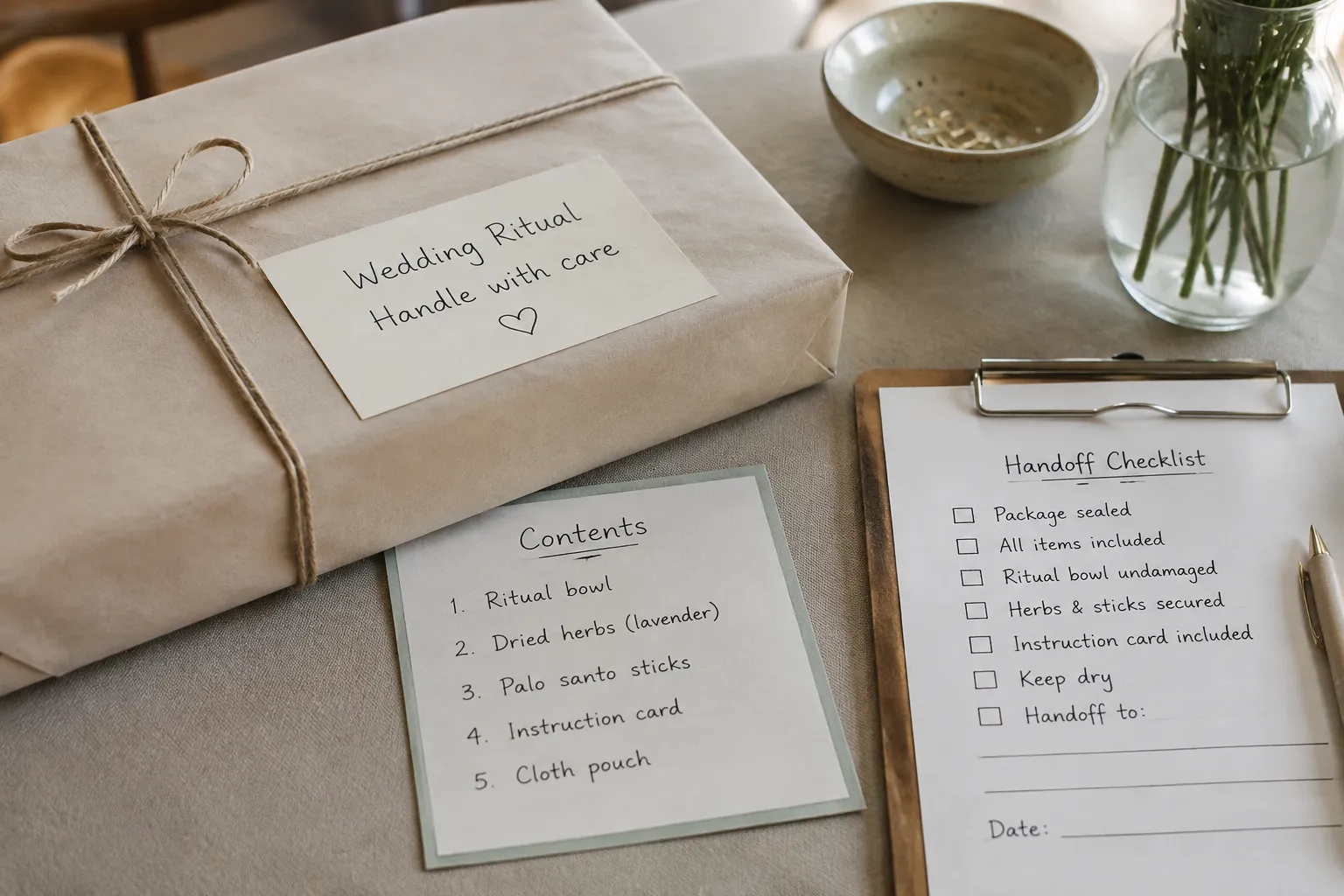
Label the outside of each package so the receiving person can identify it quickly. Include the couple’s names, object name, destination, receiving person, planned handoff time, and return destination.
Add “Do not open” or “Open with family lead” only when that instruction has been agreed. Place a contents note inside the package with the number of pieces, detachable parts, containers, fabric sections, or accompanying materials.
Labels support accountability. They do not establish cultural meaning. Avoid describing an item as compulsory or part of every Peruvian wedding unless the relevant family or ceremony lead has specifically confirmed that description.
For fragile, inherited, or difficult-to-replace objects, agree in advance who may handle them and where they will rest. Transport, storage, and access instructions should reflect the object’s actual condition and the venue’s arrangements.
The receiving person should be named before the wedding day. They confirm arrival and know where the object will remain.
- A family member
- A padrino or another chosen participant
- The ceremony lead
- A planner or coordinator
- A venue contact
- A member of the wedding party
The best choice depends on the object and ceremony. A venue contact may handle temporary storage, while a family member may manage an inherited item’s return.
Ask the receiving person where to meet, what to do if the object arrives early, who may open or move it, where it waits, who confirms placement, and who takes it home.
Add a Delivery Confirmation Step
Arrival at a venue is not the same as a completed handoff. Use a short confirmation sequence:
- The carrier identifies the object and package.
- The receiving person checks the label and contents note.
- Both people note any visible condition issue.
- The receiving person states where the object will be stored.
- The confirmation contact records the completed handoff.
- The carrier keeps the return instructions.
A message such as “The family textile arrived at the preparation room at 3:10 p.m.; Maria received it” may be enough. The record should close the communication loop without turning the celebration into an administrative exercise.
If an object is incomplete, damaged, late, or sent to the wrong location, contact the couple and the relevant ceremony or venue lead before changing the planned use.
Match the Plan to the Ceremony
The same object may be handled differently in a civil ceremony, parish ceremony, family ritual, reception, or photography session. Ask the relevant lead:
- Is the object suitable for this ceremony space?
- When should it arrive?
- May a family member carry or place it?
- Should the ceremony lead introduce it?
- Should it remain closed until a particular moment?
- Can it be moved during the ceremony?
- Does the photo timeline need a separate setup?
- Does it need to leave before the reception ends?
Civil and parish details should be confirmed with the current municipality, parish, or ceremony lead. A family wedding handoff plan can organize the object, but it cannot determine another institution’s procedures.
If the ceremony lead does not use the object, the family can decide whether it belongs at the reception or in a private family moment. Record that decision so the carrier is not waiting for an instruction that will not come.
Check Venue-Specific Arrangements
Ask the venue about the delivery entrance, access hours, temporary storage, receiving staff, setup access, photography access, and end-of-event collection.
Also clarify any placement restrictions involving candles, food, liquids, or display materials. Ask who moves the object between rooms and when it must leave.
Venue staff may coordinate delivery without taking responsibility for the object’s family meaning, ownership, or return. Keep those responsibilities separate in the plan.
If the venue cannot store the object, assign a family member to remain responsible for it. If it moves from a parish or civil location to the reception, create a second handoff row rather than assuming the first carrier will manage the full day.
Keep a Separate Return Plan
Some objects return to the family that brought them. Others may go to an older relative, remain with the couple, or return to a lender. Record who holds the object afterward, who collects it, when collection occurs, where it stays that night, and who confirms the return.
This matters when several families contribute objects. A named return plan reduces confusion after guests leave and keeps meaningful items from being packed with general decorations.
Ownership and inheritance are family matters. The person who carries an object, presents it, or pays for transport does not automatically become its owner.
A Compact Handoff Plan Example
Use this format for each item:
- Object: Family-held textile
- Use: Reception display, subject to family and venue confirmation
- Current holder: Relative in Lima
- Carrier: Named cousin
- Collection point: Relative’s home
- Collection time: Agreed afternoon window
- Receiving person: Reception coordinator or named family member
- Storage: Marked preparation area
- Opening or placement: Family-selected person, confirmed before the event
- Return: Original family holder
- Confirmation: Message sent to the couple after delivery
This example shows the planning structure without suggesting that a textile, a particular role, or a specific sequence belongs to every Peru-focused wedding.
Final Confirmation Questions
Send the completed plan to the people who control each part of the arrangement. Keep each message short and specific.
Ask the Family
- Is this the correct object name?
- Who should carry and receive it?
- Who may open, place, or present it?
- Who keeps it afterward?
Ask the Ceremony Lead
- Is the planned use suitable for this ceremony?
- When should the object arrive?
- Where should it wait?
- Does the order need to change?
Ask the Venue
- Where can the carrier enter?
- Who can receive the item?
- Where can it be stored?
- Who moves it between spaces?
- When must it leave?
Ask the Couple
- Who is the final confirmation contact?
- What happens if the carrier or receiving person is delayed?
- Which arrangements are family preferences?
- Which ceremony details require local confirmation?
The finished wedding ritual object checklist should make every handoff visible without turning a family custom into a universal requirement. Name one person for each stage, confirm ceremony details with the relevant lead, and close the loop after delivery and return.